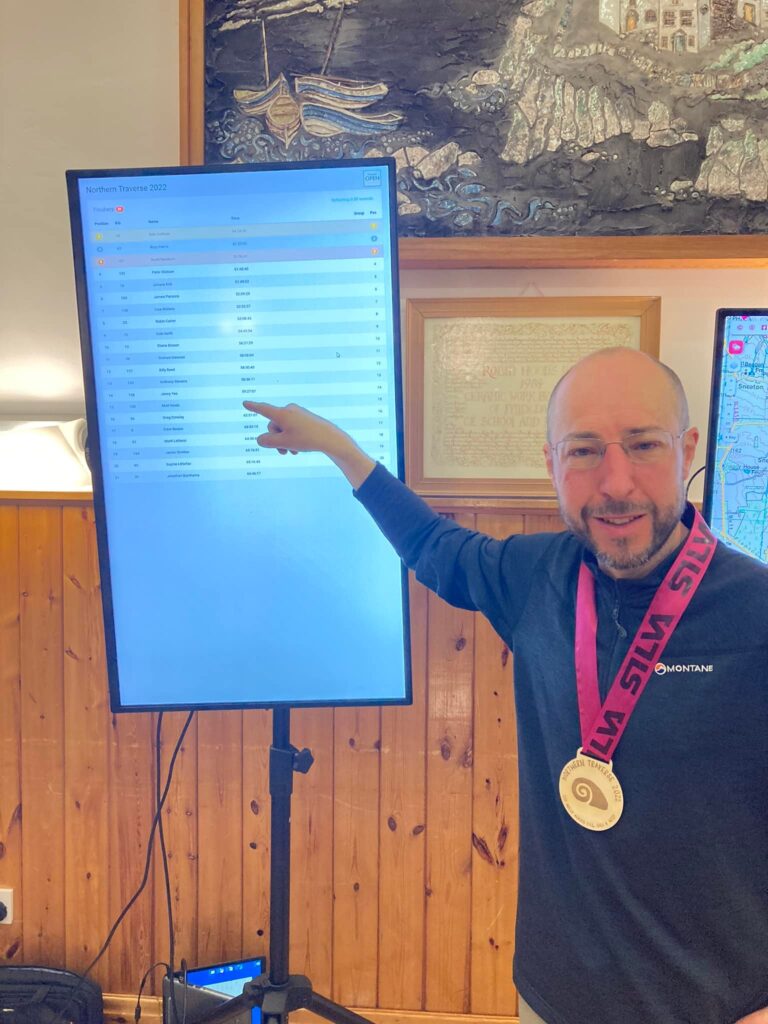
This is Anthony’s own account of this ultramarathon, which offers a slightly different challenge than what most runners are used to !
I just got back from doing the Northern Traverse, a non-stop ultramarathon following Wainwright’s Coast-to-Coast route from St Bees on the Irish Sea to Robin Hood’s Bay on the North Sea coast, comprising 300km distance and over 7,000m of elevation across the Lake District, Yorkshire Dales and North Yorks Moors.
With over 140 competitors, including a number of top ultra runners including Eoin Keith and Pavel Paloncy, who have 5 Spine Race wins between them, and Kim Collison, holder of a number of endurance running titles and records, it was a very strong field. After my relatively strong performance in January’s Spine Challenger North, and was targeting a time of 60-72 hours, depending on whether and how much time I would need for sleep breaks.
Saturday morning started off warm and sunny, and I stayed near the back for the first 5km or so in order to allow myself to gradually feel my way into the race, something that I have come to realise is quite important on these multi-day races where it’s your pace in the second half of the race that is probably more important in determining your result than how quickly you start.
I had done a lot of vertical in training, both climbing as well as descents / plyometric work, and this paid off on the 4 big climbs through the Lake District and in particular I was able to sprint down even some of the more technical descents such as Honister and Patterdale, but as the first night fell, I struggled by headlight over the snow at the top of Kidsty Pike, down its steep descent to Haweswater, and along the rocky path besides Haweswater. By the time I arrived in Shap it was 4am and I was already feeling quite tired. The temperature had now dropped to below zero, and the hours before and around dawn on the moors towards Kirkby Stephen were quite challenging, as I struggled to stay awake. Luckily after 8am, the temperature rose again and that seemed to also reduce the effects of lack of sleep and as I hit the Yorkshire Dales section, I was able to lift the pace again despite having covered almost 100 miles and started to pick up several places, moving from around 30th to 20th by the time I reached the checkpoint at Richmond (Yorkshire) at 10.20pm on Sunday evening. Most other runners tried to get a few hours sleep at Richmond, but I decided to press on after stopping for an hour to eat, stretch and change socks, as the relatively flat ground in the Vale of York between Richmond and the Cleveland Hills was very runnable even by headtorch at night, and my 60-hour plan had assumed that I didn’t get any sleep at all during the race.
Luckily, I got through this second night out with too many hallucinations or other sleep deprivation issues, and the sun was coming up as I reached the escarpment of the Cleveland Hills and the start of the final major section. Although not particularly technical terrain, 40 mph gusts of wind were blowing, it had now also started to rain, and the relentless climbs and descents on steep stepped paths were hard work, both physically and mentally, particularly as the moors became increasingly boggy and waterlogged as you went Eastward towards the coast. I tried to focus on keeping track of my pace for each km, as I knew that anything better than 12 min kilometres would see me get in under the 60 hour mark. With 10km left, I briefly stopped to check my position and found that I moved up to 13th place in the overall standings (11th in the men’s race) with a couple of runners “only” 1 km and 2km in front of me. I was gaining on them, and had the strength to sprint a few more sections, but with darkness descending, and heavy rain beginning to fall, the combination of poor visibility and a muddy, slippery clifftop path for the final few kilometres meant that I decided to prioritise personal safety and I dialled back the pace, resigning myself to just finishing out on a top-10 finish with a 58hr 36 min time, over an hour inside my “stretch target” of 60 hours.
This was a wonderful race and a result that I was really happy with, particularly as I was able to stay sleep-free and running at virtually exactly the same pace for almost 60 hours. I was also lucky enough to arrive only a couple of hours after Eoin Keith, winner of both this race’s previous editions, so he was still in the finishers’ area when I got there and I was able to spend a couple of hours chatting with him.
The next big race I have is the 250-mile Cape Wrath Ultra in May up the northwest coast of Scotland, an 8-day stage race, so no need to worry about sleep deprivation and night-time running, but a race where recovery and maintaining pace over rough ground will be key.
Best regards, Anthony